


Raising a Resilient Child: Strategies That Work

A resilient child is not a child who never cries, never struggles, or always “stays strong.” Real resilience looks like a child who can face disappointment, ask for help, tell the truth, try again, and remember that God is near.
Parents cannot remove every hard thing from a child’s path. We can, though, help build the inner strength they will carry into school, friendships, failure, grief, temptation, and change. Scripture gives a steady foundation for that work, and daily parenting gives us the practice field.

Start with a secure foundation in God’s love
Children build resilience best when they know they are loved before they perform. That truth begins with God.
Romans 8:39 reminds us that nothing “shall be able to separate us from the love of God.” A child who hears this often begins to understand that mistakes, bad days, and hard feelings do not push God away.
Make this practical by using steady phrases during tense moments:
“You are loved, even when this is hard.”
“God is with you, and I am here to help.”
“One mistake does not define who you are.”
This does not mean ignoring sin, disrespect, or poor choices. It means correction happens inside a relationship, not outside of it. Hebrews 12:6 connects discipline with love. Loving discipline teaches children that boundaries are not rejection. They are protection.
A child who feels secure is more likely to tell the truth, receive correction, and recover after failure.
Teach children to name hard feelings without shame
Many children act out because they do not yet know how to explain what is happening inside. Scripture does not ask people to pretend. The Psalms are full of grief, fear, anger, confusion, and praise.
Psalm 56:3 says, “What time I am afraid, I will trust in thee.” Notice the order. Fear is named, then trust is practiced.
Help a child build emotional language with simple coaching:
“That sounds disappointing.”
“You felt left out.”
“You were angry when the game did not go your way.”
“You can be upset and still choose what is right.”
Then connect the feeling to faith:
“Let’s tell God the truth about this.”
“What do you think God wants you to do next?”
“Let’s pray before we decide.”
This builds honest faith, not fake calm. A resilient child learns that feelings are real, but they do not have to be in charge.

Build courage through small responsibilities
Resilience grows through practice. A child cannot learn perseverance if every frustration gets removed. James 1:2-4 teaches that trials can produce patience and maturity. That does not mean parents should create hardship. It means we should not rush to rescue children from every uncomfortable task.
Give age-appropriate responsibilities and let effort matter:
Putting away toys before screen time
Apologizing after hurtful words
Finishing a chore before moving on
Trying a difficult homework problem before asking for help
Speaking kindly to a sibling after conflict
Use language that praises effort and character, not only results.
Say, “You kept trying even when it was hard,” instead of only, “You’re so smart.”
Say, “That was honest,” instead of only, “Good job.”
Galatians 6:9 says not to grow weary in doing good, because a harvest comes in due season. Children need that picture. Good choices do not always feel rewarding right away, but they still matter.
Make Scripture part of daily coping
Scripture works best in a child’s life when it is not saved only for lectures. Use it as comfort, direction, and memory.
For Raising a Resilient Child with Scripture Based Strategies That Work, choose a few verses that become family anchors.
Situation | Scripture to use | Simple child-friendly reminder |
Fear | Isaiah 41:10 | God helps me when I am afraid. |
Failure | Proverbs 24:16 | I can get back up again. |
Anger | James 1:19 | I can slow down and listen. |
Worry | Philippians 4:6-7 | I can pray instead of carrying it alone. |
Loneliness | Psalm 23:4 | God is with me in dark places. |
Keep it simple. One verse lived well is better than ten verses rushed.
Try a weekly rhythm:
Read one short passage.
Ask, “What does this show us about God?”
Ask, “How can we practice this tomorrow?”
Pray one sentence together.
Children remember what they repeat. They also remember what they see modeled.

Model repentance and repair at home
Parents teach resilience most clearly when they admit wrong and make repair. A child who never sees adults apologize may think strength means refusing to be wrong.
Ephesians 4:32 calls believers to be kind, tenderhearted, and forgiving. That begins at home.
Use short, clear repair statements:
“I spoke too harshly. I am sorry.”
“I should have listened better.”
“I was frustrated, but it was not right for me to yell.”
“Will you forgive me?”
This does not weaken authority. It shows children what humble strength looks like.
It also teaches them how to handle their own failures. They learn that guilt can lead to confession, repair, and growth instead of hiding or shame.
Help children see hardship through hope
Resilience is not built on positive thinking alone. Christian resilience rests on hope. Romans 5:3-5 connects suffering, perseverance, character, and hope. That hope does not disappoint because God’s love has been poured into our hearts.
When a child faces rejection, loss, disappointment, or change, avoid rushing to explain it all. Some pain needs presence before teaching.
Start with comfort:
“I am sorry. That really hurt.”
“God sees this.”
“We can face this one step at a time.”
Then help them look for the next faithful step:
Who can we forgive?
What can we learn?
What should we try again?
Who can we ask for help?
How can we pray about this tonight?
Hope does not deny pain. It gives pain a place to go.
Keep resilience rooted in connection
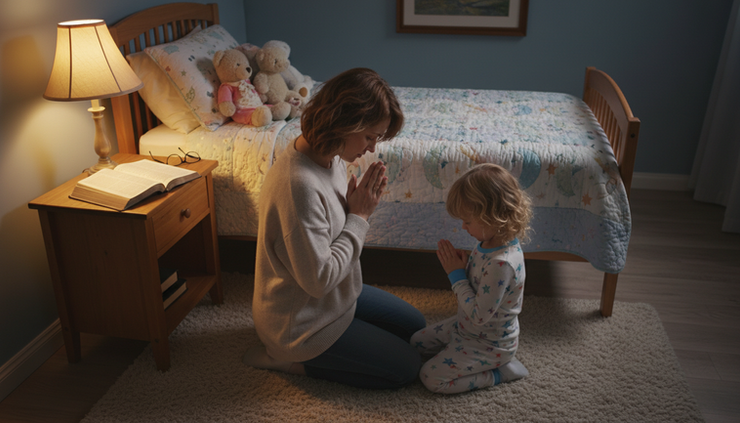
Strategies matter, but connection carries them. Children are more likely to receive Scripture when they experience warmth, patience, and steady presence.
Build small habits that say, “You are not alone.”
Eat together when possible.
Pray before school.
Ask specific questions after hard days.
Share stories of how God helped you endure.
Celebrate growth, not just achievement.
Keep showing up after conflict.
Deuteronomy 6:6-7 describes teaching God’s words diligently, while sitting at home, walking, lying down, and rising. Faith formation happens in repeated moments, not only formal lessons.
Raising a resilient child is slow, sacred work. Some days will feel ordinary. Some will feel messy. Keep planting truth. Keep practicing repair. Keep pointing your child to the God who strengthens, comforts, corrects, and stays near.
The goal is not a child who never falls. The goal is a child who knows where to turn, how to rise, and who walks with them every step of the way.


Comments